
Matching the Right Oil to your Bobcat Machine
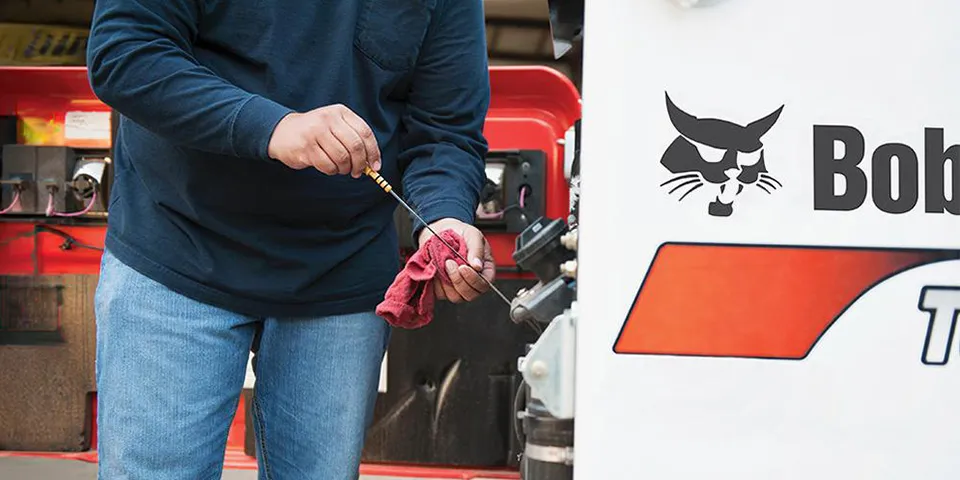
Your compact equipment relies heavily on fluids to meet Tier 4 emissions requirements, as well as performance and service-life requirements set by manufacturers such as Bobcat Company. That’s why it’s essential to use the correct engine oil, hydraulic fluid, and grease. Selecting the correct fluids for your machine optimizes its operation and allows it to achieve maximum service interval and overall service life.
Need help figuring out which oil your equipment needs? Reach out to Summit Bobcat, and we can help!
Oil classifications
Bobcat uses specifically formulated hydraulic fluids to operate at higher pressures and with more sophisticated pump and component designs. The American Petroleum Institute (API) has developed a classification system that sets minimum specification requirements for engine oil. Oil categories for use in diesel engines begin with “C.” CK-4 oils, introduced by the API in 2016, are formulated for high-speed diesel engines and are designed to meet 2017 and newer on-road and Tier 4 non-road emissions requirements. CK-4 oil formulations work with modern low-sulfur diesel fuels up to 500 parts per million (ppm) and help protect against oil oxidation, oil aeration, and viscosity loss due to shear.
CK-4 oils meet or exceed the performance requirements of CJ-4, CI-4, and CH-4 oil classifications and can be safely used in engines requiring those oils. It is essential always to use a high-grade oil that meets or exceeds the API classification of your engine.
Viscosity matching
When selecting an engine oil, ensure the viscosity rating, set by the Society of Automotive Engineers (SAE), is suitable for the outside temperature of your jobsite. Your Operation & Maintenance Manual outlines the recommended oil weights in various weather conditions. You can contact Summit Bobcat if you have misplaced your Operation & Maintenance Manual and Bobcat equipment manuals, as they are available for purchase.
Many machines roll off the production line with a 10W-30 weight oil, which offers the best performance in temperatures typically ranging from minus 20 degrees Fahrenheit (F) to 90 degrees F. A 15W-40 weight performs well from minus 5 degrees F to 110 degrees F.
Synthetic or synthetic-blended oils contain additives that can prolong the time between oil changes and extend engine life. They also provide better cold-weather starting and lubrication performance, as well as additional protection against wear when jobs demand high-speed, high-temperature operation. For example, a 5W-40 weight synthetic oil can usually offer protection in extreme conditions, from cold as low as minus 40 degrees F to as hot as 120 degrees F.
Hydraulic and Hydrostatic Oils
The formulations of hydraulic/hydrostatic oils have been updated to meet the increased demand placed on hydraulic components. There are several types of these fluids on the market, each designed for a particular application:
- High performance – Typically, a custom blend of high-quality lubricants developed to provide peak flow at subzero temperatures while maintaining stability during periods of high-temperature use.
- Synthetic – An advanced liquid technology designed to optimize cycle times and productivity, and provide good cold-weather fluidity for seasonal changes.
- Biodegradable – Introduced to meet customer demand as federal, state, and local governments set environmental-related project restrictions. It’s biodegradable, nontoxic, and formulated to minimize environmental impact.
- Grease
- Most compact equipment requires you (or your operators) to grease and lubricate the pivot points where pins and bushings are located. Bobcat specifies greasing intervals in your Operation & Maintenance Manual. If applied correctly, grease can help extend the life of components and improve the efficiency of your machine. The National Lubricating Grease Institute classifies various types of grease, which should be matched to your work conditions:
- Multipurpose #2 – Developed for standard applications, it provides lubrication to prevent rust and corrosion and protection under heavy and shock loads.
- Heavy-duty – Containing moly for better adherence to all surfaces, it offers water resistance, extreme pressure capabilities, pumpability in cold temperatures, and good seal compatibility.
- High-performance/synthetic – Formulated to provide high- and low-temperature performance in severe operating conditions, it’s intended for lube points with sliding and pivoting movements.
- Chisel extreme pressure – An extra-heavy-duty grease formulated for use in extreme pressure applications where moisture and corrosion control are critical. It remains stable in water and offers a balance between wear protection and corrosion resistance.
If you’re still asking, “What oil do I need?” contact us and determine your machine’s perfect match.